

Parental alienation can show up as sudden refusal, copied adult language, loyalty pressure, and public side-taking. The safest response is careful observation, documentation, and professional support rather than quick judgment.
When families search for 17 signs of parental alienation, they are usually trying to make sense of a child’s sudden shift in attitude, contact, or loyalty. This article explains the most commonly noticed behaviors, where they show up, and how to respond carefully without jumping to conclusions.
- Most telling pattern: Repeated rejection across time and settings.
- Watch for: Adult-sounding language and loyalty tests.
- Do not assume: One sign alone proves alienation.
- Best response: Document facts and seek support early.
What “Parental Alienation” Means in 2026 and Why the 17 Signs Matter
Parental alienation is a term people use when a child becomes strongly resistant, fearful, or dismissive toward one parent in a way that seems out of proportion to the child’s own experience. In everyday parenting conversations, it often comes up during separation, divorce, custody changes, or long-running conflict.
The 17 signs in this article are not a diagnosis. They are patterns adults may notice when a child’s relationship with one parent appears to be shaped by pressure, repeated messages, or loyalty conflicts.
How readers usually search for this topic: warning signs, custody concerns, and “is this happening in my family?”
Most readers are looking for practical clarity. They want to know whether a child’s refusal to visit, repeated negative language, or sudden emotional cutoff is a normal reaction to stress or something more concerning.
That question matters because the same behavior can have different causes. A child may be angry, overwhelmed, protecting themselves, or repeating what they hear from others.
Why this article is for awareness, not diagnosis or legal advice
This guide is meant to help parents, caregivers, teachers, and relatives notice patterns and respond thoughtfully. It is not a substitute for a family therapist, child psychologist, mediator, or attorney.
If there are safety concerns, abuse concerns, or an active custody dispute, the next step should be professional support and careful documentation, not assumptions.
17 Signs of Parental Alienation: The Behaviors People Notice First
These signs often appear gradually. Some are obvious, while others are subtle and only become meaningful when they repeat over time.
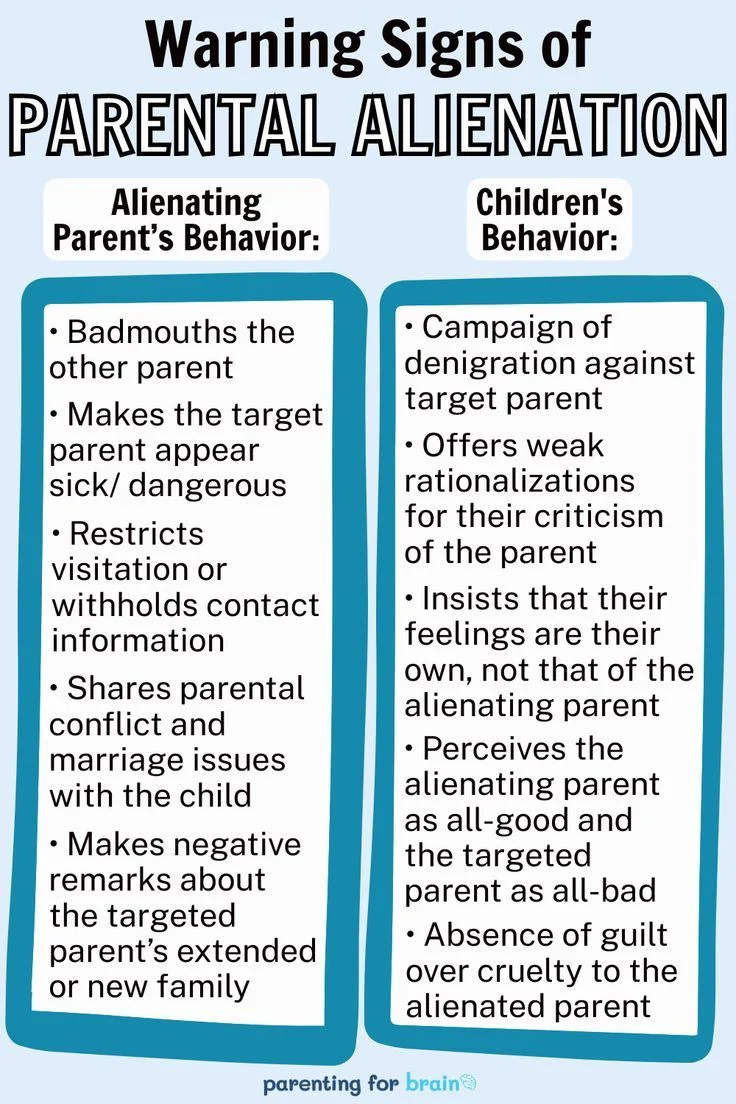
1–5: Refusing contact, sudden fear, and “all-or-nothing” loyalty shifts
1. A child refuses contact without a clear reason. They may reject calls, visits, or time with one parent even when there is no recent event that explains the change.
2. The child shows sudden fear or discomfort around one parent. The reaction can seem intense, especially if it appeared after a period of normal connection.
3. The child moves from affection to total rejection very quickly. Instead of mixed feelings, they may act as if one parent is entirely good or entirely bad.
4. The child insists on choosing sides. They may feel pressure to prove loyalty by rejecting one parent and siding fully with the other adult in the conflict.
5. The child treats ordinary rules as proof of rejection. A missed call, schedule change, or discipline decision may be described as evidence that the parent “doesn’t care.”
6–10: Repeating adult language, rejecting gifts, and false or exaggerated accusations
6. The child uses phrases that sound copied from an adult. The wording may be far more mature, legalistic, or emotionally loaded than you would expect from the child’s age.
7. The child rejects gifts, letters, or kind gestures. Items that once brought comfort may be returned, ignored, or described as manipulative.
8. The child repeats negative stories with little personal detail. The story may sound polished but thin on firsthand memory or specific context.
9. The child makes accusations that are hard to separate from adult conflict. Some claims may be exaggerated, repeated from others, or framed in a way that sounds rehearsed.
10. The child shows a sudden loss of warmth, humor, or ease with the parent. Conversations that once felt natural may become stiff, guarded, or openly hostile.
Not every accusation is alienation. If a child describes fear, harm, or coercion, treat the concern seriously and seek appropriate professional help.
11–17: Public side-taking, guilt trips, gatekeeping, and replacing one parent with another narrative
11. The child takes sides publicly. They may correct others, announce loyalty, or repeat one parent’s version of events in front of family, teachers, or friends.
12. The child feels guilty for enjoying time with the other parent. They may act anxious, apologetic, or ashamed after a positive visit.
13. The child becomes a gatekeeper for communication. They may refuse to pass along messages, hide calls, or control access to the other parent.
14. The child shows a “replacement story” about the family. They may describe one parent as unnecessary, erased, or easily swapped out in the family narrative.
15. The child uses loyalty tests. They may expect the other parent to choose sides, defend themselves constantly, or prove love in exact ways.
16. The child’s negative view spreads into unrelated areas. A disagreement about homework or bedtime may become evidence that the parent is “bad” in every way.
17. The child becomes unusually rigid about contact and narrative control. They may insist there is only one correct version of the family story and reject any nuance. [Source: EPA]
One sign alone does not confirm parental alienation. The pattern matters most when several behaviors repeat across time, settings, and relationships.
How These Signs Show Up in Real-Life Settings: Home, School, and Social Media
Alienation concerns often become easier to spot when adults compare what happens in different places. A child may act one way at home, another way at school, and another way online.
At home: bedtime, pickup time, and routine conversations that turn tense
At home, the signs may surface during ordinary routines. Pickup time can become emotionally loaded, bedtime may trigger complaints about visits, and simple questions can lead to defensive answers.
Parents may notice that a child who once talked freely now shuts down when the other parent is mentioned. Even small transitions can feel tense if the child is carrying loyalty pressure.
At school: teacher comments, parent conferences, assemblies, and behavior changes
Teachers may hear a child echo adult conflict, avoid discussing one parent, or become distressed around family-related assignments. Parent conferences can also reveal mismatched stories about who attends events and who the child talks about most.
If school behavior changes around custody transitions, it is worth noting the timing. That does not prove alienation, but it can help adults see whether the pattern is consistent.
On TikTok, texting, and family group chats: how online snippets can intensify alienation
Short videos, private messages, and family group chats can magnify conflict because they reward quick reactions and incomplete context. A single screenshot or clipped video can become “proof” in a larger family story.
Online communication also makes it easier for children to absorb adult opinions in bite-sized form. That is why calm, direct, and age-appropriate communication matters so much.
What Parents, Caregivers, and Teachers Should Watch For Without Jumping to Conclusions
Careful observation is more useful than instant labeling. The goal is to understand what the child is experiencing and what support may be needed.
Distinguishing alienation from normal conflict, separation stress, or a child’s safety concerns
Some children pull away during divorce or separation because they are grieving, confused, or angry. Others may resist contact because they feel unsafe, unheard, or overwhelmed.
That is why adults should ask: Is the reaction tied to one event, or is it a repeated pattern? Is the child expressing their own feelings, or repeating adult language with little personal detail?
When you are unsure, focus on the child’s behavior, timing, and consistency rather than on proving a theory too quickly.
Patterns that become more meaningful when they repeat across places and people
A concern becomes more meaningful when the same pattern shows up at home, at school, and in conversations with extended family. Repetition across settings can help adults separate a momentary mood from a broader dynamic.
If the child is warm with one parent in one setting but hostile in every setting after certain conversations, that pattern deserves attention and documentation.
When to document concerns and when to seek family, legal, or mental health support
Document dates, behaviors, and exact wording when possible. Keep notes factual and brief, especially if the situation may involve custody, counseling, or school support.
Seek family therapy, child-focused mental health support, or legal guidance when the conflict is escalating, the child is distressed, or communication has become impossible without help.
Jamie Reed’s Joke-Craft Tips: Using Humor Carefully Around a Heavy Topic
Humor can help families stay calm, but only when it supports understanding. In a topic like this, the safest approach is to use humor to reduce tension, not to dismiss the child’s feelings or the seriousness of the situation.
Why family humor should lighten the mood, not minimize a child’s experience
Good family humor makes hard conversations more approachable. It should never tell a child that their fear, confusion, or anger is silly.
In parenting content, the best humor usually points at shared human messiness, not at a child’s pain. That keeps the tone warm without turning the topic into a joke about the child.
Safe joke angles: awkward co-parenting moments, communication mishaps, and “we all need a calendar” humor
Gentle humor works best when it centers on logistics. Missed emails, duplicate school forms, and calendar confusion are relatable because many families have lived them.
That kind of humor can open the door to conversation. It helps readers feel seen without making anyone the punchline.
When a topic is emotionally charged, the safest laugh usually comes from the situation, not from the child, the rejected parent, or the conflict itself.
Humor that backfires: sarcasm about loyalty, “mini-me” jokes, and punching down at the child
Sarcasm about choosing sides can deepen shame. “Mini-me” jokes can also backfire if they imply ownership, pressure, or identity replacement.
Any humor that mocks the child’s confusion or treats loyalty conflict as entertainment should be avoided. In sensitive family settings, that kind of joke can do more harm than good.
Delivery Advice for Different Platforms and Audiences
The same message does not land the same way everywhere. A blog, a school talk, and a short-form video each need a different level of detail and caution. [Source: Scholastic]
Newsletter or blog tone: empathetic, clear, and non-sensational
For newsletters and blog posts, use calm language and concrete examples. Readers usually want clarity, not dramatic framing.
A thoughtful post can mention the signs, explain the limits, and encourage support without sounding accusatory. That builds trust and keeps the content useful.
School or assembly setting: respectful language, simple examples, and no blame-heavy punchlines
In schools or assemblies, keep examples broad and age-appropriate. Teachers and students should leave with understanding, not with a script for blaming one parent.
A respectful tone matters even more in mixed audiences. Some children may be living through custody stress, and a careless joke can make them feel exposed.
TikTok or short-form video: fast hooks, careful wording, and avoiding viral oversimplification
Short-form video works best when the hook is clear and the language is measured. A quick list can be useful, but it should not collapse a complex family issue into a dramatic claim.
Because clips are easy to share out of context, avoid absolute statements. Say what the signs may suggest, and remind viewers that context and professional support matter.
Viral content can oversimplify a child’s behavior. A brief clip should never replace a full conversation, careful observation, or professional evaluation.
Age-Appropriateness and Sensitivity Notes for Families and Educators
Children at different ages understand family conflict in very different ways. The way you talk about these signs should match the child’s developmental stage and emotional readiness.
How to discuss the signs with younger children without leading them
With younger children, ask open-ended questions and avoid suggesting answers. Simple prompts like “How do you feel when you go between homes?” are safer than “Is someone telling you not to like Mom or Dad?”
Keep the focus on feelings, routines, and safety. Younger children may not have the language to explain loyalty pressure directly.
What teens may understand differently and how to keep the conversation calm
Teens often understand more about conflict, manipulation, and identity. They may also resist being managed, so calm curiosity works better than confrontation.
Give teens room to speak in their own words. If they feel interrogated, they may shut down or become more defensive.
When a joke is too advanced, too bitter, or too specific for mixed-age audiences
Mixed-age audiences need simpler, safer humor. A joke that feels clever to adults may confuse younger children or seem too pointed for a family setting.
If the humor depends on bitterness, hidden blame, or insider details, it is probably too sharp for children or school audiences.
In family communication, clarity often does more good than cleverness. A plain sentence can reduce tension faster than a joke with a complicated setup.
Final Recap: The 17 Signs, the Humor Guardrails, and What to Do Next
The most recognizable signs include refusal of contact, sudden fear, copied adult language, rejection of affection, public side-taking, and rigid loyalty pressure. The key is not to react to one isolated moment, but to watch for repeated patterns across time and settings.
Quick summary of the most recognizable patterns
Look for sudden shifts, repeated negativity, gatekeeping behavior, and language that sounds borrowed from adults. Also pay attention to whether the child’s reactions appear in more than one place, such as home, school, and online.
Reminder that supportive observation beats snap judgment
Careful notes, calm conversations, and professional support are more helpful than accusations. The goal is to protect the child’s well-being and preserve healthy relationships wherever possible.
Closing takeaway from PunRealm: use humor to open the door, not close the conversation
At PunRealm, the best family humor is the kind that makes hard topics easier to approach without making anyone feel dismissed. When the subject is parental alienation, humor should support empathy, clarity, and safe next steps.
- Watch for repeated patterns, not one-off reactions.
- Notice changes across home, school, and online spaces.
- Do not confuse concern with diagnosis.
- Use calm documentation and professional support when needed.
- Keep humor gentle, respectful, and child-centered.
Frequently Asked Questions
Common signs include refusing contact, sudden fear of one parent, copied adult language, and strong loyalty shifts. The pattern matters more than any single behavior.
Yes. A child may act one way at home and another way at school, so it helps to compare behavior across settings.
No. Divorce stress can cause withdrawal or anger, but parental alienation concerns usually involve repeated negative patterns and loyalty pressure.
Yes, if you are seeing repeated concerns. Keep factual notes about dates, behaviors, and exact wording, and seek professional guidance when needed.
Teachers should stay neutral, observe patterns, and share factual concerns with the appropriate school contact or caregiver. They should not diagnose the situation.
Yes, if it is gentle and respectful. Humor should reduce tension and open conversation, not make the child or a parent the punchline.