

Focus on boundaries, support, and safety instead of trying to change the parent. Use humor only if it helps you feel grounded and does not increase conflict.
Dealing with a narcissistic parent is not about winning arguments or changing someone who refuses accountability. It is about protecting your mental health, setting limits that hold up under pressure, and building enough support to stay grounded.
This guide on how to deal with a narcissistic parent focuses on realistic coping, safety, and communication that reduces harm. It also keeps PunRealm’s family-humor lens in mind: not to minimize pain, but to show how careful, low-stakes humor can help people regain a sense of control.
- Safety first: If there is threat or abuse, get outside help quickly.
- Boundaries matter: Short, calm limits work better than long explanations.
- Contact is flexible: Low-contact or no-contact can be healthy choices.
- Support helps: Trusted adults, friends, and counselors can reduce isolation.
- Humor should heal: Keep it private, observational, and non-shaming.
What “How to Deal with a Narcissistic Parent” Really Means in 2026
User intent: support, safety, and realistic coping—not fixing the parent
In 2026, people searching this topic usually want practical help, not a label debate. They may be trying to survive a difficult conversation, manage a holiday visit, or decide whether more distance is necessary.
The most useful answer is rarely “say the perfect thing.” More often, it is: reduce exposure, protect your boundaries, and stop measuring your worth by the parent’s reaction.
Why this topic matters for PunRealm’s family humor audience
Family humor often works because it names everyday tension people already recognize. But with a narcissistic parent, the goal is not to turn pain into a cute family quirk.
Humor can still help readers feel less isolated, especially when it is observational and restrained. Used well, it gives people a small emotional reset without asking them to pretend the situation is harmless.
Recognizing Narcissistic Parent Behaviors Without Self-Diagnosing the Whole Family
Common patterns: guilt trips, boundary pushing, image management, and emotional whiplash
A narcissistic parent may use guilt to control decisions, ignore direct requests, or act charming in public and harsh in private. Some parents also focus heavily on appearances, making the family look “fine” while ignoring the emotional cost at home.
Another common pattern is emotional whiplash: warmth one moment, criticism the next. That unpredictability can make children and adults alike second-guess themselves and stay in a constant state of alert.
How to separate occasional selfishness from a harmful ongoing pattern
All parents can be self-centered sometimes. The difference is whether the behavior is occasional and repairable, or repeated, manipulative, and resistant to accountability.
Ask a simple question: when you name a hurt, does the person listen and adjust, or do they deny, blame, mock, or punish? A harmful pattern tends to repeat even after clear feedback.
When the situation may require professional or legal support
If the parent’s behavior includes threats, stalking, financial control, physical aggression, or interference with your housing, education, or safety, outside support matters. A counselor, school advocate, domestic violence service, attorney, or trusted institution may be appropriate depending on the situation.
If you feel unsafe, do not treat this as a communication problem. Safety planning and outside help are more important than having another difficult conversation.
How to Protect Yourself First: Boundaries, Distance, and Support Systems
Setting emotional boundaries that do not invite debate
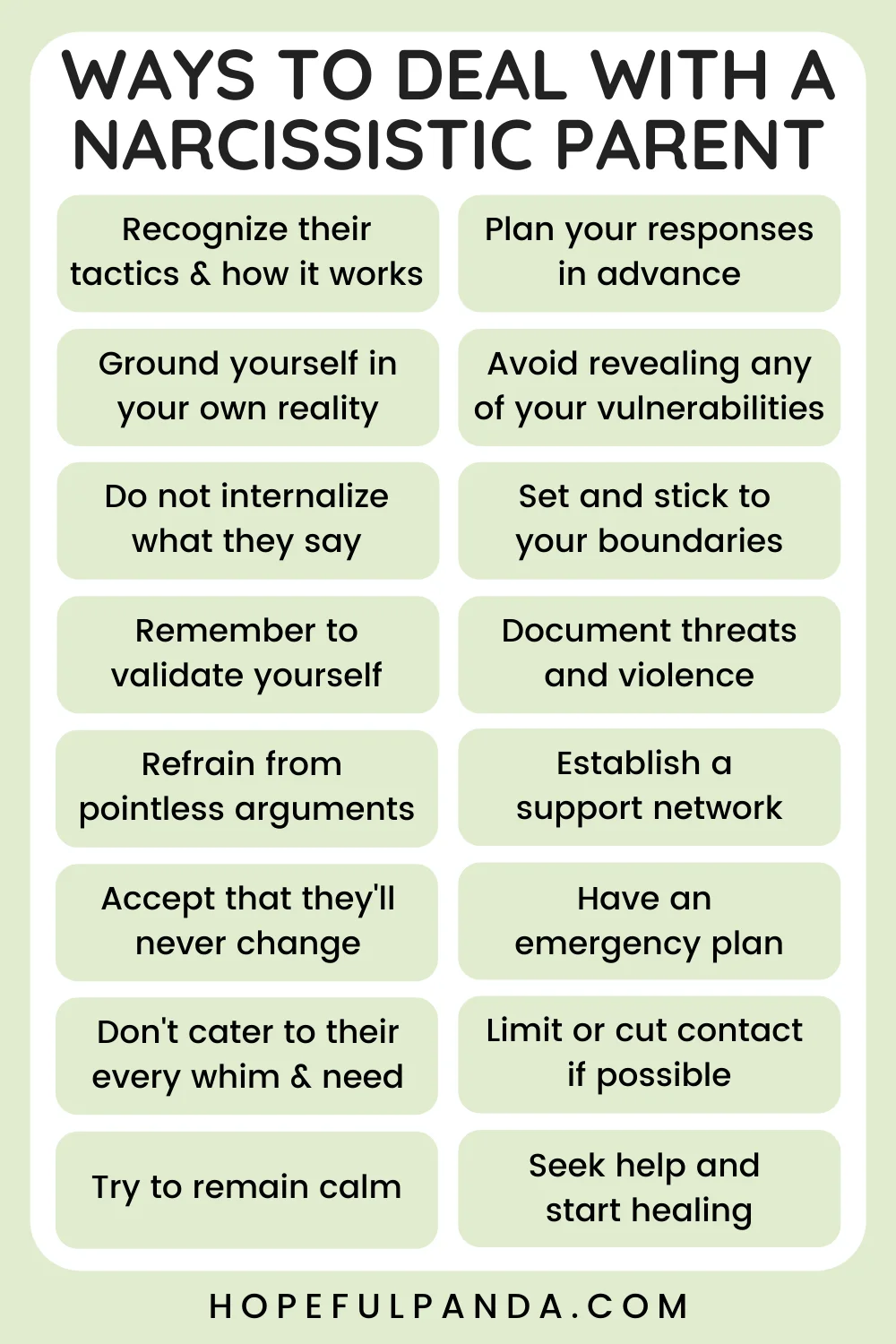
Boundaries work best when they are short, clear, and not over-explained. Long explanations often give a controlling parent more material to argue with.
Examples include: “I’m not discussing that,” “I’ll leave if this turns insulting,” or “I can talk for ten minutes, then I need to go.” The point is not to persuade; the point is to define your limit.
Say the boundary once, then repeat it calmly. A steady repeat is usually stronger than a detailed defense.
Using low-contact, structured contact, or no-contact when needed
Not every relationship can be repaired through better wording. Some people do better with low-contact, meaning fewer calls, shorter visits, and more control over timing and topics.
Others need structured contact, such as only speaking by text or only meeting in public places. In severe cases, no-contact may be the healthiest option, especially if repeated contact keeps reopening harm.
Building a support circle: friends, counselors, teachers, relatives, and trusted adults
A difficult parent relationship becomes heavier when you carry it alone. Support can come from one trusted friend, a school counselor, a mentor, a relative who stays calm, or a therapist who understands family dynamics.
If you are a teen or young adult, a trusted adult can help you reality-check what is happening and plan next steps. If you are an adult, support may also include a partner, a support group, or a therapist familiar with family estrangement and boundary-setting.
When you need a broader parenting or family-life perspective, it can help to read related practical guidance such as funny space jokes for school or clean space jokes captions for examples of how tone changes across audiences and settings.
Safety notes for teens, college students, and adults still living at home
If you live at home, your first priority may be safety and stability, not confrontation. That can mean keeping important documents accessible, saving emergency contacts, and identifying where you could go if a conflict escalates.
College students may need to protect access to tuition, housing, or phone plans. Adults still dependent on a parent may need a quiet exit strategy rather than a dramatic announcement.
If you are financially or physically dependent on the parent, plan carefully before changing contact levels. A safer plan is usually better than a fast one.
Where Humor Fits: Using Safe, Low-Stakes Comedy to Cope Without Escalating Conflict
Why humor can help readers reclaim control and reduce stress
Humor can help people name a pattern without becoming swallowed by it. A well-placed line in a private journal, text to a trusted friend, or quiet moment after a tense exchange can create emotional distance.
The key is that the humor should support the person using it, not provoke the parent or turn the relationship into a public fight. In difficult families, private humor is often safer than performative humor. [Source: CDC]
Joke craft tips from Jamie Reed: timing, understatement, and observational humor
For this topic, the strongest humor is usually observational rather than sharp-edged. Timing matters: a brief, understated line often lands better than a long setup or a dramatic roast.
Observation works because it describes the pattern plainly. For example, a caption about “the family member who remembers every birthday except the apology” is less explosive than direct insult and more useful for readers who want recognition, not escalation.
When humor is used for coping, the best line usually points at the pattern, not the person’s dignity. That keeps the message readable, safer, and less likely to trigger a larger conflict.
Best formats for this topic: short captions, newsletter one-liners, school-friendly examples, and TikTok voiceover beats
Short captions work well because they are easy to read and easy to stop reading if the tone is too much. Newsletter one-liners are useful when the goal is warmth with a practical takeaway.
School-friendly examples should stay neutral and avoid direct family shaming. TikTok voiceover beats can work if the pacing is calm and the text overlay frames the experience as relatable, not sensational.
Short, specific observations usually feel funnier than broad exaggeration because they sound more true to life. That is one reason restrained humor often works better than big, loud delivery in sensitive topics.
Age-appropriateness notes: what works for teens, adults, and mixed-age family settings
Teens may respond well to simple, relatable lines that validate frustration without encouraging disrespect. Adults may handle more nuance, especially when the humor is paired with boundary advice.
Mixed-age family settings require extra caution. What feels clever in a private message may feel hurtful in a living room, classroom, or public event.
Delivery Advice for Sensitive Parenting Humor Across Platforms
School setting: keeping the message supportive, not disruptive or disrespectful
In schools, the safest approach is to focus on coping and emotional literacy rather than family conflict details. A line about “everyone has one relative who tests patience” is far safer than a direct attack on a parent.
Teachers and presenters should avoid making students feel exposed. The best school delivery leaves room for private identification without forcing public disclosure.
TikTok: pacing, text overlays, and avoiding “trauma as a punchline” energy
TikTok rewards fast pacing, but sensitive topics need room to breathe. Use clear text overlays so viewers can follow the point without relying on a harsh punchline.
Avoid turning abuse, manipulation, or family pain into entertainment bait. If the content feels like it is laughing at the pain instead of helping viewers name it, it is too far.
Newsletter or blog: balancing warmth, clarity, and practical takeaways
Longer formats are ideal for pairing a gentle line with an actual coping strategy. That combination builds trust because readers get both recognition and direction.
A newsletter or blog can say, in effect, “This is hard, here is why, and here is what you can do next.” That is often more valuable than trying to be clever every paragraph.
Assembly or live audience: voice, pauses, and reading the room carefully
Live delivery depends on the room. A supportive audience may appreciate a light observational line, while a tense or unfamiliar audience may not.
Use pauses to let a practical point land. If the audience seems uncomfortable, move quickly back to safety, boundaries, and reassurance rather than pressing for laughs.
Common Humor Mistakes to Avoid When Talking About Narcissistic Parents
Turning abuse into a quirky family stereotype
Not every difficult parent is narcissistic, and not every family conflict is a joke. Turning harmful behavior into a quirky stereotype can make real pain look trivial.
Keep the focus on patterns and impact, not on making dysfunction seem charming.
Using sarcasm that shames the reader instead of validating them
Sarcasm can easily become a second wound. If the humor implies that the reader should have handled the situation better, it stops being supportive.
Validation should come first. Humor should make the reader feel less alone, not more blamed.
If a joke makes someone feel foolish for struggling, it is not coping humor anymore. It is just another form of pressure.
Overdoing the jokes and losing the self-protection message
Too many jokes can blur the main point: protect yourself. When every line is trying to be clever, the reader may miss the boundary advice entirely.
Use humor as a support beam, not as the whole building.
Making the parent the only punchline when the goal is healing and boundaries
It can be tempting to turn the parent into a cartoon villain. But if the article is meant to help readers heal, the emphasis should stay on their choices, safety, and next steps. [Source: Healthline]
The most useful tone is firm, not theatrical. It says, “This is serious, and you deserve options.”
Practical Scripts and Coping Moves Readers Can Use Right Away
Short boundary phrases that stay calm and firm
Try short phrases that do not invite debate: “I’m not available for that topic,” “That doesn’t work for me,” “I’m ending this conversation now,” or “We can talk later when it is calmer.”
These phrases work because they are simple. They do not accuse, explain, or over-negotiate.
Pick the limit you can actually keep, such as ending a call after insults or leaving a room when yelling starts.
Say it once in a calm voice. Avoid long explanations that invite argument.
If the behavior continues, leave, mute, hang up, or stop replying for the moment.
Exit lines for phone calls, texts, and in-person pressure
Phone call exit lines can be as simple as, “I need to go now,” followed by ending the call. Text exit lines may read, “I’m not discussing this by message,” or “I’ll respond later if needed.”
For in-person pressure, use a physical exit if possible: “I’m stepping outside,” “I have to leave,” or “We can continue another time.”
Self-check habits after stressful interactions: journaling, breathing, and reality-checking
After a difficult interaction, write down what was actually said, what you felt, and what you need next. That helps separate facts from the self-doubt that often follows manipulation.
Slow breathing, a short walk, or a trusted text message can also reset your nervous system. The goal is to come back to your own judgment before making the next decision.
When to seek counseling, advocacy, or emergency help
Seek counseling when the relationship leaves you anxious, frozen, ashamed, or unable to trust your own memory. Seek advocacy if the parent controls money, housing, school access, or communication in ways that trap you.
If there is immediate danger, threats, or violence, contact emergency services or a local crisis line right away. Do not wait for the “right” conversation to happen first.
Final Recap: Protecting Yourself, Keeping Perspective, and Using Humor Wisely
Key takeaways on safety, boundaries, and emotional distance
The most important part of dealing with a narcissistic parent is protecting yourself first. That may mean shorter contact, firmer boundaries, more support, or stepping back entirely.
You do not need to prove the parent is difficult before taking your own pain seriously. If the pattern is harming you, the response can be practical and protective.
How PunRealm’s family humor lens can support—not minimize—real pain
Family humor can be useful when it helps people feel seen and less alone. It should never pressure someone to laugh off behavior that needs boundaries or outside help.
Used carefully, humor can create a little breathing room. That breathing room can make it easier to think clearly, ask for support, and choose the next right step.
Closing reminder that the goal is resilience, not winning the argument
You do not have to win every exchange to protect your peace. In many cases, the real victory is leaving less drained, less confused, and more connected to reality.
That is the heart of how to deal with a narcissistic parent: stay clear, stay supported, and use every safe tool available to protect your well-being.
- Focus on safety and boundaries, not fixing the parent.
- Use low-contact or no-contact if repeated harm continues.
- Keep humor private, observational, and non-shaming.
- Reach out for counseling or advocacy when the situation escalates.
Frequently Asked Questions
Look for a repeated pattern of guilt trips, boundary pushing, blame-shifting, and emotional whiplash. Occasional selfishness is different from ongoing behavior that keeps harming you.
Start with one clear boundary and keep it short. If the situation feels unsafe, focus on distance, support, and a safety plan instead of a confrontation.
No-contact is a personal decision, and it is most appropriate when repeated contact keeps causing harm or danger. Many people begin with low-contact or structured contact before making a final decision.
Yes, if it is private, low-stakes, and used to help you regain perspective rather than provoke conflict. Humor should support healing, not minimize abuse or shame the person using it.
Treat it as a safety and planning issue, not just a communication issue. Reach out to a counselor, trusted adult, advocate, or legal resource before making major changes.
Seek help if you feel trapped, constantly anxious, or unable to trust your own judgment after interactions. Get urgent support right away if there are threats, violence, stalking, or other immediate safety concerns.