

In Michigan, unmarried parents usually need to establish legal parentage before a court can fully decide custody and parenting time. The court then focuses on the child’s best interests, daily routine, and long-term stability.
Understanding child custody laws in Michigan for unmarried parents starts with one core idea: legal parentage matters before custody decisions can fully move forward. If you are trying to figure out rights, parenting time, or how to protect your child’s routine, Michigan law gives you a clear process, but it can feel confusing at first.
This guide explains what changes in 2026, how parentage is established, and how courts decide custody and parenting time. It also covers common co-parenting situations and practical next steps for parents who want a stable plan for their child.
- Parentage first: Legal custody rights usually depend on establishing parentage.
- Best interests rule: Michigan courts prioritize the child’s safety, stability, and needs.
- Different custody types: Legal custody and physical custody are not the same thing.
- Practical plans matter: School, childcare, and holidays should be clearly mapped out.
Child Custody Laws in Michigan for Unmarried Parents: What Changes in 2026?
Why readers search this topic: clarity, rights, and next steps
Most parents search this topic because they want straightforward answers. They may be wondering whether both parents have rights, whether a father must be named on a birth certificate, or how to ask the court for a custody order.
For unmarried parents, the biggest issue is often not just custody itself, but the legal steps needed to get there. Michigan family courts look first at whether parentage is legally established, then at what arrangement serves the child’s best interests.
How Michigan treats custody, paternity, and parenting time for unmarried parents
In Michigan, an unmarried mother is generally recognized as the child’s legal parent from birth. A father or second parent usually must establish parentage before asking the court for custody or parenting time orders.
That distinction matters because custody, parenting time, and decision-making rights depend on legal recognition. Once parentage is established, the court can evaluate custody using the same best-interest framework it uses in other family cases.
Custody disputes can be emotionally heavy, especially when parents are no longer living together. If you are collecting information for a real case, keep documents organized and focus on your child’s daily needs, not just disagreements between adults.
Establishing Legal Parentage in Michigan
Why paternity matters before custody orders can move forward
Parentage is the legal foundation for custody rights. Without it, a court may not be able to issue a full custody and parenting time order for an unmarried father or other parent seeking recognition.
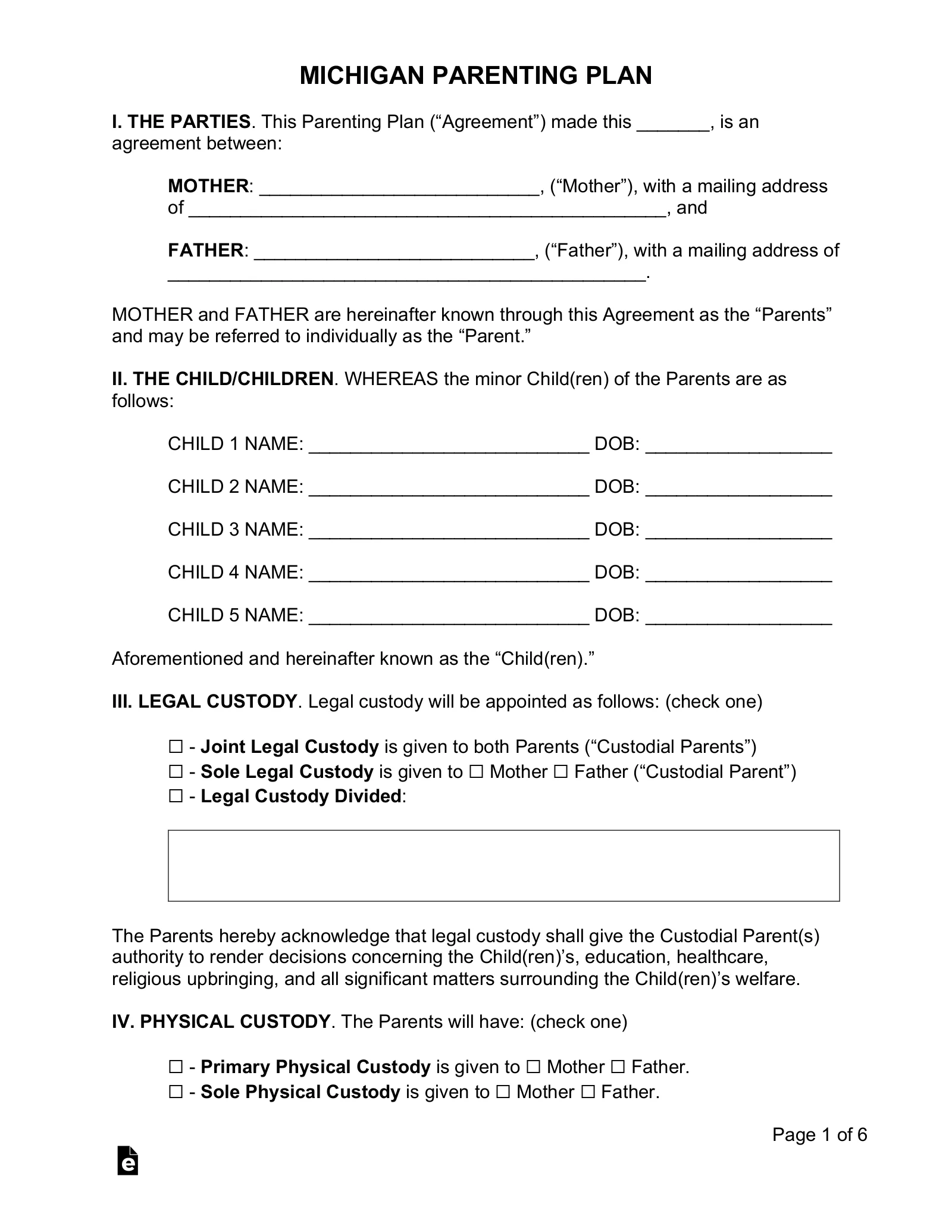
This is why many custody cases begin with questions about paternity or parentage. The court needs to know who the legal parents are before it can decide who makes decisions for the child and how parenting time should work.
Voluntary acknowledgment vs. court-ordered paternity
Michigan parents may establish parentage voluntarily in some situations, such as by signing an acknowledgment form. In other cases, the court may need to order genetic testing or hear evidence before parentage is confirmed.
Voluntary acknowledgment is often faster when both parents agree. Court-ordered paternity becomes more important when there is disagreement, uncertainty, or a need to correct the legal record.
Common mistakes parents make when parentage is unclear
One common mistake is assuming that being present at birth automatically creates custody rights. Another is assuming that child support paperwork alone settles parentage questions.
Parents also sometimes delay legal action, which can make schedules, school decisions, and healthcare choices harder to manage. If parentage is unclear, it is usually better to address it early rather than wait until a conflict grows.
Do not rely on informal promises alone if you need a lasting parenting arrangement. A text message or verbal agreement may help explain the history, but it usually does not replace a court order.
How Michigan Courts Decide Custody and Parenting Time
Best interests of the child factors in real-world terms
Michigan courts use the child’s best interests as the central standard. In practical terms, that means the judge looks at the child’s safety, stability, emotional needs, school life, home environment, and each parent’s ability to meet daily responsibilities.
The court may also consider the child’s relationship with each parent, how well the parents communicate, and whether each home can support a consistent routine. The focus is not on rewarding one parent or punishing the other; it is on creating a workable plan for the child.
Legal custody vs. physical custody explained simply
Legal custody is about who makes important decisions, such as education, medical care, and major religious or developmental choices. Physical custody is about where the child lives and how time is shared between homes.
Parents sometimes assume these are the same thing, but they are different. A parent may have parenting time without sole legal custody, or the court may divide decision-making while still giving one parent the child’s primary home.
When judges may favor joint arrangements or one primary home
Judges may favor joint arrangements when both parents can cooperate, live close enough for a practical schedule, and keep conflict away from the child. Joint custody is more likely when communication is steady and the child can move between homes without excessive disruption.
One primary home may be better when parents live far apart, work schedules are inconsistent, or conflict is high. In those cases, the court may still give the other parent meaningful parenting time while keeping the child’s routine more stable.
When you prepare for court, think in terms of routines: bedtime, school drop-off, childcare, and transportation. Judges often respond well to plans that sound realistic instead of aspirational.
Co-Parenting Scenarios Unmarried Parents Commonly Face
Parents living together, separated, or never in the same household
Unmarried parents may still be living together when custody questions arise, or they may have separated long before they start talking about a legal plan. Some parents never shared a household at all, which can make coordination more formal from the beginning. [Source: EPA]
Whatever the history, the court will still look at the child’s current needs. A parent who has been the child’s daily caregiver may have a different role than a parent who is just beginning to build a regular routine.
When one parent wants to move or change the schedule
Relocation can affect school, childcare, transportation, and the child’s relationship with both parents. If one parent wants to move, the court may review how the move changes the existing custody arrangement and whether the child’s best interests are still protected.
Schedule changes can also happen when work hours shift or a parent’s living situation changes. The key question is whether the new plan still supports consistency, communication, and the child’s daily needs.
How school routines, childcare, and holidays affect custody plans
School routines often shape custody more than parents expect. A schedule that looks fair on paper may be hard to maintain if it complicates homework, bus pickup, or daycare transitions.
Holidays and breaks also matter because they can either reduce conflict or create it. A strong parenting plan usually spells out school breaks, birthdays, summer time, and holiday rotation clearly so there is less room for disagreement.
If you are comparing family-life topics across PunRealm, it may help to read related child-focused resources like baby care decision guides and infant travel safety articles that also emphasize practical routines for caregivers.
Child Custody and Family Humor: What Jamie Reed Would Never Joke About in Court
Using humor safely in family content without minimizing legal stress
Family humor can be useful in content because it lowers tension and helps readers stay engaged. But custody and parentage are not places for exaggerated punchlines, because the stakes are real and the people involved may already feel overwhelmed.
In legal or parenting content, humor should support understanding, not distract from it. The safest approach is light, observational phrasing that never makes the child, the court, or a parent’s hardship the target.
Age-appropriateness notes for jokes about custody, family change, and parenting
What works for adults in a blog post may not work in a classroom, a school presentation, or a teen-focused video. Younger audiences usually need simpler language and less irony, while older audiences may understand gentle wordplay if it stays respectful.
When family change is the subject, age-appropriate content should avoid making children feel responsible for adult conflict. The goal is to explain, not to turn a serious topic into a performance.
Common humor mistakes: sarcasm, blame, and “my ex” punchlines that backfire
Sarcasm can sound clever to the writer but dismissive to readers who are living through a custody dispute. Blame-based humor also tends to age poorly, especially when the audience includes parents trying to co-parent with less conflict.
“My ex” punchlines may get attention, but they can also make the content less trustworthy. In family-law topics, clarity and empathy usually work better than edgy lines that turn one parent into a punchline.
When writing about serious family topics, use humor to describe the situation, not the people in it. That keeps the tone human without making the reader feel mocked or dismissed.
Best Settings for Explaining Custody Topics With Humor in 2026
School presentations: keeping it respectful and age-aware
In school settings, custody topics should be framed with care and simple language. A classroom audience may include children from many family structures, so the tone should be inclusive and never assume one “normal” home setup.
Any humor used in this setting should be mild, brief, and supportive of the lesson. If it risks embarrassment or confusion, it is better left out.
TikTok and short-form video: fast clarity without legal oversimplification
Short-form video can make custody topics more accessible, but it also encourages oversimplification. A quick clip can explain a basic concept like legal custody versus parenting time, but it should not pretend to replace legal advice or a full explanation.
Humor works best here when it is visual, simple, and tied to a common parenting moment. Fast delivery helps, but only if the message remains accurate.
Newsletters and blog posts: balancing empathy, accuracy, and light wit
Blog posts and newsletters give you room to explain the law clearly while keeping the tone warm. That makes them a better fit for subtle wit than a live setting where timing can be harder to control.
For this format, a little personality can help readers stay with a serious subject. Still, the legal information should always be easy to find and not buried under style.
Assembly or community talk: tone, timing, and audience sensitivity
Assemblies and community talks often include mixed ages, different family backgrounds, and people who may be dealing with stress quietly. That means humor should be used sparingly and only when it serves the audience. [Source: CDC]
If the room is formal, the safest choice is a respectful tone with very light warmth. Overly clever lines can make serious content feel less credible.
In family-law communication, the clearest message is often the most memorable one. Readers usually trust content more when the tone feels calm, direct, and respectful.
Joke Craft Tips and Delivery Advice for Family-Law Content
How to use wordplay without sounding dismissive
Wordplay can work if it is light and does not rely on someone’s pain. The safest wordplay in family content usually comes from everyday parenting routines, not from conflict itself.
If a line could sound like you are minimizing a custody dispute, it probably needs revision. The best test is simple: would this still feel respectful if a stressed parent read it at 11 p.m.?
Delivery tips: pacing, pause, and punchline placement
Good delivery matters even in written content. A short setup, a clear transition, and a quick payoff help readers understand the point without feeling lost.
In spoken settings, pauses can help a harmless line land, but too much buildup can make a serious topic feel theatrical. Keep the emphasis on the information first and the style second.
When to choose gentle observational humor over edgy jokes
Gentle observational humor works best when it reflects a shared parenting reality, like calendar confusion or the challenge of coordinating schedules. It is easier for mixed audiences to receive because it feels familiar rather than confrontational.
Edgy jokes are riskier because custody topics already involve stress, uncertainty, and strong feelings. If the goal is trust, gentle observation is usually the stronger choice.
How to keep the focus on support, not spectacle
Supportive content answers the reader’s real question and leaves them with a clearer next step. Spectacle tries to get attention first and understanding second.
For family-law topics, support should win every time. That means using humor only when it helps the reader stay engaged, not when it steals the spotlight from the information.
- Parentage usually needs to be established before custody orders move forward.
- Michigan courts focus on the child’s best interests, daily routine, and stability.
- Legal custody and physical custody are different parts of a parenting plan.
- Clear schedules for school, holidays, and childcare reduce conflict.
- Respectful, age-aware humor can support family content, but it should never minimize legal stress.
Final Recap: What Unmarried Parents in Michigan Should Remember
Key custody takeaways, parentage basics, and practical next steps
If you remember only a few things, start with these: establish parentage first if it is not already clear, keep the child’s routine at the center of every decision, and use written agreements or court orders when you need lasting structure.
Michigan custody decisions for unmarried parents are driven by the child’s best interests, not by who is louder or more frustrated. Clear records, realistic schedules, and calm communication usually help parents move toward a more stable plan.
If you are also looking for family-friendly reading that keeps a lighter tone, PunRealm offers playful content such as clean space jokes captions and funny space jokes for school for a different kind of family-safe break.
Closing note from PunRealm’s Jamie Reed on keeping family humor kind, clear, and age-appropriate
Family humor works best when it helps people feel seen without making their situation feel smaller. For custody topics, especially, the most responsible approach is simple: be accurate, be kind, and keep the child’s well-being at the center of the conversation.
Frequently Asked Questions
An unmarried mother is generally recognized as the child’s legal parent from birth. Custody and parenting time still depend on the court order or agreement if the parents need a formal plan.
Paternity establishes legal parentage for the father or other parent seeking rights. Without that step, the court may not be able to fully address custody and parenting time.
Legal custody covers major decisions like education and medical care. Physical custody covers where the child lives and how parenting time is shared.
Yes, if joint custody fits the child’s best interests and the parents can make it work. The court looks at communication, stability, and the child’s routine.
A move can affect the parenting schedule, school routines, and the child’s relationship with each parent. The court may review the change if it affects an existing custody arrangement.
Informal agreements can help parents cooperate, but they usually do not replace a court order. A written order is more reliable when parents need long-term clarity.