

Parents arguing can affect children differently by age, but the biggest factors are tone, frequency, and how adults repair afterward. Calm reassurance, clear boundaries, and age-appropriate honesty help kids feel safe and supported.
When parents argue, kids do not just hear the words. They read the room, track the tone, and try to figure out whether home still feels safe. This guide explains how conflict affects children at different ages and what parents can do to repair the moment and reduce the damage.
- Safety first: Children need to know the disagreement is not their fault.
- Tone matters: Harsh delivery can feel worse than the topic itself.
- Repair helps: Calm apologies and reassurance reduce fear and confusion.
- Age matters: Toddlers, school-age kids, and teens process conflict differently.
- Prevention matters: Private timing and clear conflict rules protect kids from carrying adult stress.
Why Parents Arguing Hits Kids So Hard in 2026
Parents arguing is not new, but modern family life can make it feel bigger and harder to escape. Kids may hear conflict through open doors, group chats, shared calendars, voice notes, and the general speed of daily life.
What matters most is not whether a disagreement happened. What matters is whether children can tell that adults are still in control, still respectful, and still available after the argument ends.
What readers are really looking for: reassurance, clarity, and next steps
Most people searching about parents arguing want three things: reassurance that their child is not ruined by one fight, clarity about what the behavior means, and practical steps they can use right away. That is a reasonable request. Children need adults who can explain conflict without making it feel mysterious or terrifying.
Families also need language that fits real life. A toddler does not need a lecture. A teen does not need a speech that sounds scripted. The best response is calm, age-appropriate, and honest.
How modern family life makes conflict feel louder in homes, group chats, and routines
In many homes, conflict does not stay in one room. It can show up in a missed pickup, a tense text thread, a change in dinner plans, or a parent who is visibly distracted while helping with homework. Kids notice these shifts quickly.
That is why parents arguing can feel louder now, even when the volume is not high. The stress spreads through routines, and children often feel the tension long before anyone says, “We need to talk.”
How Parents Arguing Affects Kids by Age Group
Children do not all react the same way. Their age, temperament, and sense of security shape how they interpret conflict. A strong response in one child may look very different in another.
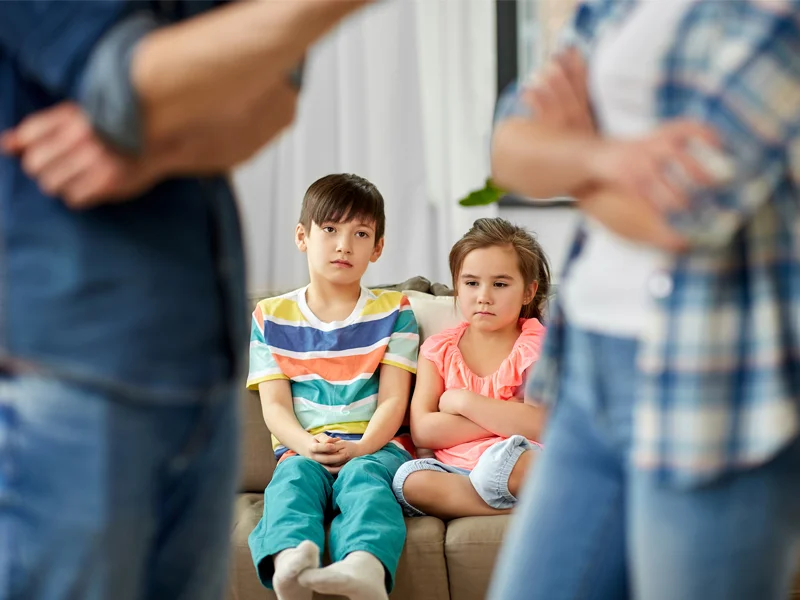
Toddlers and preschoolers: confusion, clinginess, and stress signals
Very young children usually do not understand the topic of the argument. They understand the emotion. Raised voices, sharp tone, and sudden silence can trigger clinginess, crying, sleep trouble, or regression in habits like toileting or bedtime routines.
They may also act out because they cannot name what feels wrong. A toddler might become extra needy after parents arguing, not because they are difficult, but because they are trying to stay close to safety.
Elementary-age kids: self-blame, behavior shifts, and school spillover
School-age children often try to make sense of conflict by linking it to themselves. They may wonder whether they caused the fight by misbehaving, asking for help, or needing attention at the wrong time.
That self-blame can show up as irritability, withdrawal, stomachaches, trouble focusing, or changes at school. If a child becomes more distracted or more oppositional after repeated conflict at home, it may be a stress response rather than simple defiance.
Teens: withdrawal, sarcasm, loyalty conflicts, and social media sensitivity
Teens usually understand more of what is happening, but that does not make it easier. They may withdraw, become sarcastic, or feel forced to “pick a side.” Some teens act like they are unaffected while quietly carrying the stress.
Social media can add another layer. A teen who sees parents arguing in a public post, a passive-aggressive caption, or a family group chat can feel embarrassed, angry, or pressured to manage the adults’ emotions.
What Kids Hear When Parents Argue: The Hidden Message Problem
Children rarely remember every word. They remember patterns. They remember whether voices got kinder or harsher, whether someone apologized, and whether the conflict ended with repair or with silence.
Why tone matters more than the topic
The subject of a disagreement matters, but tone often matters more to children. Two adults can disagree about money, chores, or plans in a calm way, and a child may feel less alarmed than if the same topic is delivered with contempt or shouting.
Kids are especially sensitive to tone because it tells them whether the relationship still feels intact. Harsh tone can make a small issue feel like a family emergency.
How repeated conflict can teach kids the wrong “normal”
When parents argue often and never repair, children may learn that tension is the default way adults relate. That can affect how they handle friendships, dating, and future disagreements.
They may also become hypervigilant, scanning for mood changes and trying to prevent blowups. Over time, that kind of emotional monitoring is exhausting for a child.
When a joke lands as comfort versus when it feels like dismissal
Light humor can help after tension, but only if it does not erase the child’s feelings. A simple, warm comment can reassure a child that the adults are calm again.
By contrast, joking too soon can sound like dismissal. If a child is still worried, “We were just kidding” may feel like the adults are asking them to ignore what they clearly heard.
Children usually respond better to repair than to performance. A sincere, age-appropriate explanation is more helpful than trying to act cheerful before the tension has actually passed.
What to Do After an Argument: Repair Steps That Actually Help
The goal after an argument is not to pretend nothing happened. The goal is to calm the environment, clarify what the child needs to know, and show that adults can recover from conflict in a healthy way.
How to calm the room before trying to explain anything
First, lower the emotional temperature. That may mean stepping into separate rooms, taking a few minutes before speaking, or agreeing not to continue the conversation in front of the children. [Source: WebMD]
Once the room is calmer, children can hear reassurance more clearly. If the adults are still visibly upset, even a good explanation may not land.
Use a short reset phrase such as, “We had a disagreement, and we are working it out.” It is simple, honest, and usually enough for younger children.
Age-appropriate apologies and reassurance phrases parents can use
For toddlers and preschoolers, keep it brief: “That was a loud moment. You are safe. We love you.” The message should be about safety, not details.
For elementary-age kids, add a little more clarity: “We disagreed, and that is not your fault. Adults sometimes argue, and we are handling it.”
For teens, respect their awareness without making them the mediator: “We had a hard conversation. You do not need to take sides, and we will keep you out of the middle.”
When to involve a counselor, teacher, or trusted family support
If conflict is frequent, intense, or affecting a child’s sleep, schoolwork, behavior, or mood, outside support can help. A school counselor or pediatrician may notice patterns that parents are too close to see.
If the home environment includes yelling, intimidation, or fear, it is important to seek professional help promptly. Children should not be left to manage adult conflict on their own.
Do not ask a child to interpret, report, or mediate the argument. That places adult responsibility on a child and can deepen anxiety and loyalty conflicts.
Jamie Reed’s Humor Craft Tips: Using Lightness Without Making It Worse
Humor can be helpful in families, but timing and tone matter. The point is not to make light of the conflict itself. The point is to reduce tension without denying what happened.
When family humor can lower tension and when it should wait
Humor works best after the repair has started and the child looks ready to re-engage. It can be useful during a calm moment, a routine task, or a transition back to normal life.
It should wait when emotions are still high, when a child looks worried, or when the disagreement involved a serious issue. In those moments, clarity is more useful than levity.
Simple joke styles that are safer around kids: gentle wordplay, self-aware humor, and shared relief
Gentle wordplay can soften a room without targeting anyone. Self-aware humor can also work if it focuses on the adult’s own mistake, not the child’s feelings or the spouse’s character.
Shared relief is often the safest form: a light, honest comment that acknowledges the moment is over. That kind of humor can signal, “We are okay now,” without turning the conflict into a spectacle.
Good family humor usually reduces pressure, not truth. If a line needs the child to ignore what they heard, it is probably not the right line for that moment.
Humor mistakes to avoid: sarcasm, teasing a spouse, and “we’re fine” jokes that confuse children
Sarcasm can sound clever to adults and threatening to children. Teasing a spouse in front of a child can also reopen the tension instead of closing it.
“We’re fine” jokes are especially risky if the child clearly knows the adults were not fine a minute ago. Children trust consistency more than performance.
In family communication, a calm tone often does more work than a perfect script. Children tend to remember how safe a conversation felt, not whether the wording was polished.
Best Ways to Talk About Parents Arguing in Different Settings
The right explanation depends on where the conversation happens. A home conversation, a school check-in, and a public post each call for a different level of detail.
At home: short, honest explanations that fit the child’s age
At home, keep the explanation short and concrete. Children usually need to know that the disagreement is between adults, that it is not their fault, and that the adults are handling it.
If the child asks more questions, answer only what is appropriate for their age. You do not need to share every detail to be honest.
At school or with teachers: what to share and what to keep private
If conflict is affecting attendance, concentration, behavior, or emotional regulation, a teacher or counselor may need a simple heads-up. Share enough to help them support the child, but keep private details private.
A useful approach is to say, “There has been some family stress at home, and we are watching for changes.” That gives the school context without turning them into family mediators. [Source: Scholastic]
On TikTok, newsletters, or family humor posts: keeping the message kind, clear, and non-explosive
If a family chooses to talk about conflict online, the message should stay kind and non-inflammatory. Public posts can be misunderstood quickly, especially when children or relatives are involved.
For family humor content, avoid turning a real argument into a performance. A safer approach is to talk about the general experience of parenting stress rather than exposing private conflict.
At an assembly or community talk: framing conflict as something kids can understand without fear
In a school assembly or community setting, the message should be broad, reassuring, and practical. Children should leave understanding that disagreements happen, repair matters, and adults are responsible for keeping kids safe.
This is not the place for graphic details or blame. It is the place for a steady message: conflict is part of life, but children should not have to carry it.
How to Prevent Future Blowups Kids Don’t Need to Carry
Prevention is not about never disagreeing. It is about disagreeing in ways that protect the child from emotional overload.
Setting conflict rules for volume, timing, and language
Couples and co-parents can agree on rules before the next tense moment arrives. For example: no yelling, no insults, no arguing in front of the kids, and no continuing a fight when either adult is too angry to think clearly.
Rules work best when both adults can name them in advance. They are much harder to follow if they are invented in the middle of a blowup.
Choosing private spaces and better moments for hard conversations
Hard topics should happen in private whenever possible. If children are nearby, it helps to pause and reschedule rather than pushing through a conversation that is getting sharper by the minute.
Timing matters too. Conversations after bedtime, before school, or during a rushed morning often go badly because no one has the attention or energy to stay calm.
If a conversation is getting too heated, use a neutral pause phrase like, “Let’s come back to this later.” That protects the child from hearing the rest of the blowup.
Modeling disagreement without making kids the audience
Children can learn a healthy lesson from seeing adults disagree respectfully. They learn that conflict does not automatically mean rejection, and that repair is part of relationship life.
But they should not have front-row seats to every hard conversation. Modeling works best when the child sees the resolution, not the rawest version of the fight.
Final Recap: What Kids Need Most When Parents Argue
Children do not need perfect parents. They need adults who can protect them from unnecessary fear, explain conflict in age-appropriate ways, and repair what happened afterward.
The three takeaways: safety, repair, and consistency
First, children need safety. They need to know they are not responsible for the argument and that the adults are in charge.
Second, they need repair. A calm apology, a clear reassurance, and a return to routine do more than pretending nothing happened. Third, they need consistency, because steady follow-through helps them trust that the home is still stable.
Closing note from PunRealm’s family humor lens: keep the warmth, lose the wound
At PunRealm, the family humor lens is simple: warmth can help, but it should never hide the wound. In moments of parents arguing, the best support is honest, calm, and kind.
Keep the warmth. Lose the wound. That is what children remember as care.
Frequently Asked Questions
Children are most affected by the tone, frequency, and repair after the argument. Many feel unsafe, blame themselves, or become more withdrawn when conflict is repeated.
Keep it short, calm, and age-appropriate. Reassure them that the disagreement is not their fault and that the adults are handling it.
No, disagreement itself is not the problem. The main concern is whether the conflict becomes harsh, frequent, or unresolved in front of the child.
Get help if conflict is frequent, intense, or affecting sleep, school, mood, or behavior. A counselor, pediatrician, or teacher can help you decide next steps.
Yes, when the apology is sincere and age-appropriate. It teaches children that repair is normal and that adults can take responsibility.
Yes, but only after the room has calmed and the child feels safe again. Humor should reduce tension, not dismiss the child’s feelings or hide the conflict.